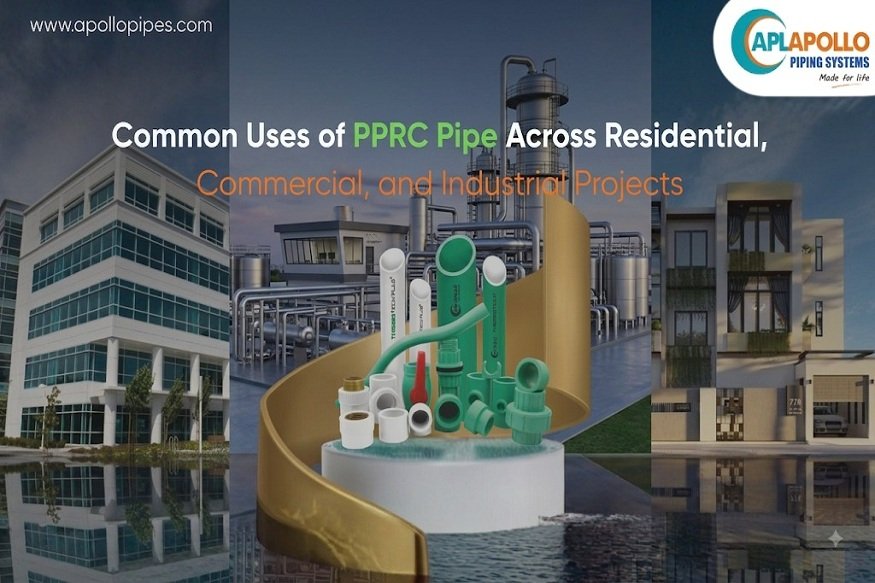
Modern plumbing and piping systems require materials that can handle everyday water supply demands while offering durability, hygiene, and ease of installation. A PPRC pipe, made from polypropylene random copolymer (PP-R), is widely used for water distribution and selected industrial piping applications. Its combination of corrosion resistance, lightweight construction, temperature resistance, and heat-fusion jointing makes PPRC piping suitable for a range of residential, commercial, and industrial projects.
PPRC Pipe Applications in Residential Projects
Residential plumbing is one of the most common applications for a PPRC pipe. Homes require reliable systems for distributing water to kitchens, bathrooms, utility areas, and other fixtures. PPRC pipes can be used for domestic water supply, including both cold-water and hot-water lines where the selected system is designed for the required operating conditions.
Read More: Common Uses of PPRC Pipe Across Residential, Commercial, and Industrial Projects
In bathrooms, PPRC piping can connect water supplies to showers, taps, washbasins, and other fixtures. In kitchens, it can be used for water distribution lines supplying sinks and appliances where appropriate. It is also suitable for plumbing connected to water heaters, provided the pipe system is selected according to the expected temperature and pressure.
Another advantage for residential plumbing is that PPRC pipes do not corrode like conventional metallic piping. Their smooth internal surfaces can also help support efficient water flow. Because PPRC systems are relatively lightweight, handling them during construction or renovation can be simpler than handling heavier metallic alternatives.
PPRC Pipe Applications in Commercial Projects
Commercial buildings often have more extensive plumbing networks than individual homes. Offices, hotels, hospitals, schools, shopping complexes, restaurants, and residential towers may require piping systems capable of supplying water across multiple floors and numerous outlets.
A PPRC pipe can be used in commercial hot and cold-water plumbing networks, including distribution lines to bathrooms, kitchens, utility areas, and other water-consuming facilities. Hotels and hospitals, for example, may have substantial hot-water requirements, making temperature suitability an important consideration when selecting the piping material.
In schools and office buildings, PPRC piping can be incorporated into domestic water distribution systems. In larger facilities, designers can plan dedicated pipe networks based on flow requirements, pressure conditions, building height, and fixture demand.
The heat-fusion method used with PPRC systems is another practical consideration. Properly executed fusion joints create a continuous connection between pipe and fitting, reducing reliance on mechanical connections in the fused sections. Correct preparation, heating, alignment, and cooling are essential for achieving reliable joints.
PPRC Pipe Applications in Industrial Projects
Industrial piping requirements vary significantly depending on the process, fluid, temperature, pressure, and operating environment. Therefore, PPRC should not be treated as a universal replacement for every industrial pipe material.
Where technically suitable, PPRC piping systems can be used for process-water distribution, industrial water supply, and selected fluid-handling applications. PPRC’s resistance to corrosion can be useful in environments where metallic piping may be exposed to corrosive conditions.
Some PPRC piping systems may also be suitable for chemical handling or compressed-air applications, but suitability must always be confirmed against the specific fluid, chemical concentration, temperature, pressure, and manufacturer’s technical data. Industrial designers should therefore evaluate compatibility before specifying PPRC piping for these duties.
Industrial plumbing may also include utility-water networks, service lines, and other applications where the operating conditions fall within the capabilities of the selected PPRC system. Proper engineering assessment remains essential, particularly for critical processes.
Why PPRC Pipes Are Suitable for Different Projects
Several characteristics explain the growing use of PPRC pipes across different types of projects.
Corrosion resistance: PP-R is resistant to corrosion, making it suitable for water conveyance where rust can be a concern with metallic pipes.
Lightweight construction: PPRC pipes are comparatively lightweight, which can simplify transportation, handling, cutting, and installation.
Temperature resistance: PPRC piping systems can be designed for hot and cold-water applications, subject to their specified temperature and pressure ratings.
Hygienic water conveyance: PPRC is widely used for water-supply applications, and appropriate systems can provide a hygienic means of transporting water.
Heat-fusion installation: Pipe and fittings can be joined through heat or poly-fusion welding. When performed correctly, this produces a homogeneous connection between compatible components.
Low maintenance potential: The material’s corrosion resistance and the use of fused joints can help reduce maintenance requirements when the system is correctly designed and installed.
Choosing the Right PPRC Pipe System
Selecting the right PPRC pipe involves more than choosing a diameter. Project requirements should be assessed before installation, including the type of fluid, operating temperature, working pressure, required flow rate, installation environment, and expected service conditions.
Read More: How New Construction in Phoenix Displaces Scorpion Populations
For hot-water systems, the pipe’s temperature rating and pressure capability should be checked. Industrial applications require additional evaluation of chemical compatibility and process conditions. Designers should also select compatible fittings and follow the manufacturer’s jointing instructions.
Installation quality is equally important. Pipes should be cut and prepared correctly, and heat-fusion equipment should be used according to the system’s installation procedure. Proper support, alignment, expansion considerations, and protection from unsuitable environmental conditions should also be addressed.
Conclusion
From residential plumbing to large commercial water networks and selected industrial applications, PPRC pipes provide a practical option where their material properties and operating ratings match project requirements. Their corrosion resistance, lightweight construction, temperature capability, hygienic water conveyance, and heat-fusion jointing make them suitable for many modern piping systems. However, correct product selection and professional installation remain essential for dependable performance.
For projects considering an established PPRC plumbing system, Apollo Pipes Limited offers its PPR-C Plumbing System in four variants—Mono Layer, Triple Layer, Thermotech, and Thermotech Plus. According to the company’s official product page, the system is made from Polypropylene-Random Copolymer (PP-R), uses poly-fusion welding for end connections, and is specified for a working temperature range of -20°C to 95°C. The product page lists reference standards includingIS 15801 and DIN 16962, along with working-pressure options depending on the specification. It also lists features including UV resistance, chemical resistance, heat-fusion jointing, thermal insulation, no scaling, and resistance to bacterial growth. Pipe sizes range from 20 mm to 50 mm, while fittings are up to 110 mm, with specific sizes and pressure classes varying by product. These details make APL Apollo’s PPR-C Plumbing System a product option worth evaluating against the technical requirements of the intended project.